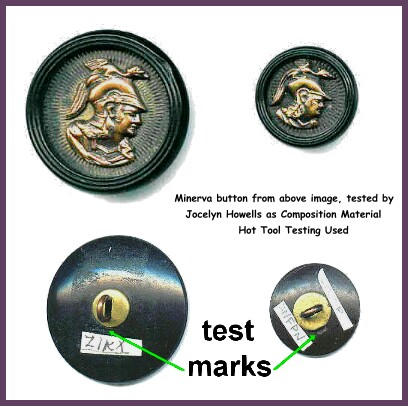
 Minerva composition button shown closer below. Tested with hot tool as compo, not gutta percha. |
 |
 |
 |
 BOOK  James W. Hall Goodyear Rubber Buttons Book |
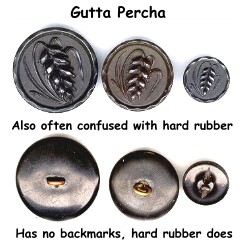
in a book called Early Plastics by Sylvia Katz. "Gutta-percha is a completely natural plastic, and from the mid nineteenth century until the 1930s it was moulded into many domestic and industrial products. Often mistakenly though to be a type of rubber,it is a hard substance scrapped by hand form Palaquium trees in Malaya, Borneo and Sumatra. Cleaned, kneaded and softened in hot water, it becomes a malleable plastic. Gutta-percha can be thought of as an early type of polythene. Many of the objects it was moulded into, such as buckets, containers, tubing and board games, have been made in polythene for many years. In 1843 samples of gutta-percha reached England in the shape of tool handles and small animal sculptures made by natives in Malaya. Micheal Faraday identified its excellent insulating properties and its acid resistance made it immediately suitable for the expanding photographic industry. In 1845 the Gutta Percha Comapny was established in London and its first major commission was to insulate the submarine telegraphic link between England and France. Bewley designed the first extrusion machine in 1845, and gutta-percha was one of the first plastics to be extruded. All kinds of tubing were extruded, as were lengths of imitation wood mouldings for panels and friezes, almost identical to modern foamed polyurethane designs." (Thanks to Robyn G. for providing this info.) Here's some additional information about Gutta Percha provided by Jocelyn Howells ((c) 2004 by author, Jocelyn Howells. All rights protected): GUTTA PERCHA is the sap from tropical Malaysian Palaquium trees in the form of milky latex, a rubbery substance that is chemically the same as that other tree extract, rubber, but the shape of the molecule gives it different properties. 1. Gutta percha buttons may have a mixture of gutta percha latex and rubber. 2. Usually dark colored, but may range from dark yellow through red to dark brown and black. 3. Resembles rubber but is glossier and lighter weight than rubber. Buttons are often fairly thin wafers with separately molded gutta percha escutcheons, although one-piece examples do exist with nicely molded surface designs. 4. Some composition and Vulcanite buttons are misidentified as gutta percha. 5. Gutta percha functions well in water, but doesn't do so well exposed to other elements. I read that many gutta percha items became brittle with use and are easily broken. 6. Rub it with your thumb or hot needle it, and it will not have that acrid sulfur smell of rubber - it's a much "sweeter" and milder rubbery smell. That can vary if blended with some rubber. 7. Taste test: Salty. Just touch the tip of your wet tongue to the back of a suspected gutta percha button. Salt sensors are located on the tip, and your saliva is needed to conduct the taste. Be aware that not everyone's ability to taste is the same, and may be affected by factors such as medicines you are taking. 8. Gutta percha is harder than rubber and has excellent molding properties that lent it so well to detailed buttons, giving them a better defined and "crisper" look than rubber or compositions. (c) 2004 by author, Jocelyn Howells. All rights protected. |
 |
 |
Links: |
Page 2 |
Ginny Flis Article Page 3 |
The Charles Goodyear Story: Page 4 |
Auction Value Results Page 5 |
Rubber & Other Buttons FOR SALE |
Button Info. Index |
 My eBay Ads |
 |